

The lease was signed, the keys were in my hand, and I remember standing in the middle of my very first empty New York apartment feeling like I had finally won. I had not won. I had, in fact, just signed up for a summer of hauling a window air conditioner up four flights of stairs and discovering, mid-turn on the top landing, that my beautiful thrifted couch was about two inches too wide to make the corner. Not one person had prepped me for any of it. So consider this me prepping you.
My husband and I have set up more first apartments in this city than I care to admit, because New York has a way of making you move every couple of years whether you planned to or not. Rent jumps. A roommate leaves. Every single time, I relearn the same lessons I swore I had memorized. This is the stuff I wish someone had said out loud before I signed anything, the unglamorous logistics of turning four bare walls into a place you can live. Not the Pinterest version. The real one, with the sweat and the box fans and the trip to the laundromat at 8pm on a Sunday.
Brace yourself. Some of this is going to sound absurd if you have never lived here. It is all true.
The window AC unit will humble you
Let me start with the one that genuinely shocked me. Most New York apartments do not come with air conditioning. Not central air, not a wall unit, nothing. If you want to be cool between June and September, that is on you, and the way you do it is by buying a heavy metal box and installing it in your window. By yourself. Usually while balancing on a radiator.
The first summer, I bought the biggest unit I could carry, wrestled it into the bedroom window, and felt very proud for about four minutes before my husband pointed out that the whole thing was resting on nothing but the friction of a lowered sash and my own optimism. This is how ACs end up on the sidewalk. Do not be me. Level the unit so it tilts very slightly toward the street, because that is how the condensation drains away from the building instead of pooling inside your wall and rotting the window frame. I skipped that step my first summer and had a brown water stain spreading down the plaster by August to show for it.
 Soho-04213.jpg
Soho
Here is the part that actually matters for safety. If you live in a building six stories or taller, the city requires your window AC to be secured with a mounting bracket on the outside, under Local Law 11. That is not a suggestion. A unit that falls from the fifth floor is a genuine danger to the people below. Even in a shorter walk-up, if the window is old or loose, get a bracket anyway. They run about thirty to fifty dollars and take twenty minutes, and they are the difference between a working AC and a lawsuit.
One more thing worth knowing, because it is genuinely changing. The city passed a law in early 2026, nicknamed Cool Homes For All, that will eventually require landlords to provide cooling that keeps bedrooms at or below 78 degrees from mid-June to mid-September. The catch is the timeline. Tenants cannot start formally requesting it until March 2028, and full enforcement does not kick in until June 1, 2030. And even then, the landlord provides the unit, but you still pay for the electricity to run it. So for the next few summers, assume the AC is your problem. Buy the bracket. Save your back.
If you are still in the middle of the search and none of this feels real yet, I put together an honest survival guide to renting your first NYC apartment that covers what to look for before you ever get to the AC stage.
Nobody has a washing machine. Welcome to laundromat life.
I grew up in Oregon, where a washer and dryer in the home is just a normal thing a house has, like a kitchen sink. Then I moved to New York and discovered that in-unit laundry is a luxury feature that can add hundreds of dollars a month to your rent. Most of us do not have it. Most of us have a relationship with a laundromat instead, and that relationship becomes weirdly personal.
 nyc-1002387.jpg
Golden Rule Wine & Liquor Store · West Village
You have two options and you will use both. Option one is doing it yourself, dragging a rolling cart or a giant IKEA bag of dirty clothes down the block, feeding quarters or a laundry card into machines, then sitting in a fluorescent room for an hour and a half guarding your stuff. Option two, the one that will change your life, is wash and fold. You drop off a bag of dirty laundry, and a few hours later you pick it up clean, dried, and folded into neat little bricks. It is priced by the pound, and in New York in 2026 you are generally looking at somewhere between two and three dollars a pound, a bit more if you want pickup and delivery.
Confession time folks. For my first year here I did every load myself to save money, sitting in that laundromat with a book, feeling very virtuous. Then I did the math. A big bag of wash and fold ran me maybe twenty five dollars and gave me back three hours of my weekend and a stack of laundry folded better than I have ever folded anything. Twenty five dollars for three New York hours back? That is a steal. These days I do sheets and towels as wash and fold without a second thought and only DIY the delicates. One thing to know before you hand over the bag, the folks who fold your clothes will fold everything, so put the hand-wash-only sweater in a separate bag unless you want it back at half its size.
One small tip that took me years to figure out. Buy the biggest, sturdiest laundry bag you can find, the kind with backpack straps. A four-flight walk-up with forty pounds of wet laundry in a flimsy bag is a special kind of misery. Straps change everything.
The walk-up furniture problem is a math problem
Here is the sentence that will save you a hundred dollars and a friendship. Measure the doorway. Then measure the stairwell. Then measure the tightest turn on the landing. Do this before you buy a single large piece of furniture, because the great tragic ritual of the New York walk-up is watching four adults try and fail to get a sofa around a corner while a delivery guy checks his watch.
 WestVillageNYC-00319.jpg
West Village
My husband and I once bought a genuinely beautiful thrifted couch from a place downtown. It was solid, it was cheap, it was perfect. It also could not physically enter our apartment. The doorway at the top of the stairs was too narrow at the diagonal, and no amount of tilting, hooking, or gentle profanity was going to fix it. We ended up selling it to our downstairs neighbor for less than we paid, whose door happened to be four inches wider. A whole afternoon and a real loss, all of it avoidable with a tape measure.
So measure everything. Width of the doorway, but also the diagonal, because a couch goes through at an angle. The narrowest point on the stairs, including the handrail, which always eats a few inches. And the ceiling height above the top step, because you often have to tilt a piece nearly vertical to clear the last corner. If a piece is close, look for furniture that ships in parts or a sofa you can partially disassemble. Some New York movers will take the legs and arms off a couch, carry the pieces up separately, and rebuild it inside. It costs extra. It is worth every penny compared to a couch that lives on the sidewalk.
And honestly? This is the case for buying less, and lighter. My favorite pieces in every apartment I have had were the ones I could carry myself. A bookshelf that came flat in a box. A bed frame that broke down into six pieces. When you move as often as New Yorkers move, the heavy solid-wood dream armoire becomes an anchor you will curse in eighteen months. Buy what fits through the door and up the stairs, and let the rest go.
The lighting situation, and other apartment mysteries
Walk into your first empty New York bedroom, flip the switch by the door, and there is a decent chance nothing happens. No overhead light comes on. You will stand there confused, as I did, convinced the electricity is broken. It is not broken. A huge number of New York apartments simply do not have ceiling fixtures in the bedrooms. The electrical code lets a switched wall outlet count as your lighting, so that switch by the door controls a plug in the wall instead of a light in the ceiling. It is a money-saving construction shortcut that has been standard here forever.
 dearest-nyc-1003479.jpg
Macy's Herald Square · Herald Square
So your very first shopping trip should include lamps. A couple of floor lamps, a table lamp for the nightstand, and you have a warm, livable room without touching the wiring. Honestly I came to prefer it. Overhead lighting is harsh, and a room lit by three soft lamps feels like a home in a way a single ceiling bulb never does. Plug one of them into the switched outlet so you can still kill the lights from the doorway, which is the small luxury you did not know you were missing.
A few other small mysteries, quickly. The “dishwasher” is often a drying rack and your own two hands. The radiator heat in winter is not something you control, it is something that happens to you, and it can get so aggressive you crack a window in January. And storage is a fantasy, so the space under the bed and the top of the closet are prime real estate. Get bed risers and flat storage bins on day one. You will need them by day three.
What to buy first, and what to skip
When you are staring at an empty apartment and a limited budget, the order matters. Here is how my husband and I actually do it, refined over too many moves.
Buy first, no debate: a real mattress and bed frame, because sleeping well is the whole game and an air mattress “just for a week” always turns into two months. Lamps, per the entire section above. A shower curtain and basic kitchen stuff, since you need to shower and eat on night one. A good fan, and if it is summer, the AC and its bracket. Cheap sturdy shelving. And a shower caddy plus over-the-door hooks, because you have no storage and every vertical surface is opportunity.
 west-village-tree-lined-street.jpg
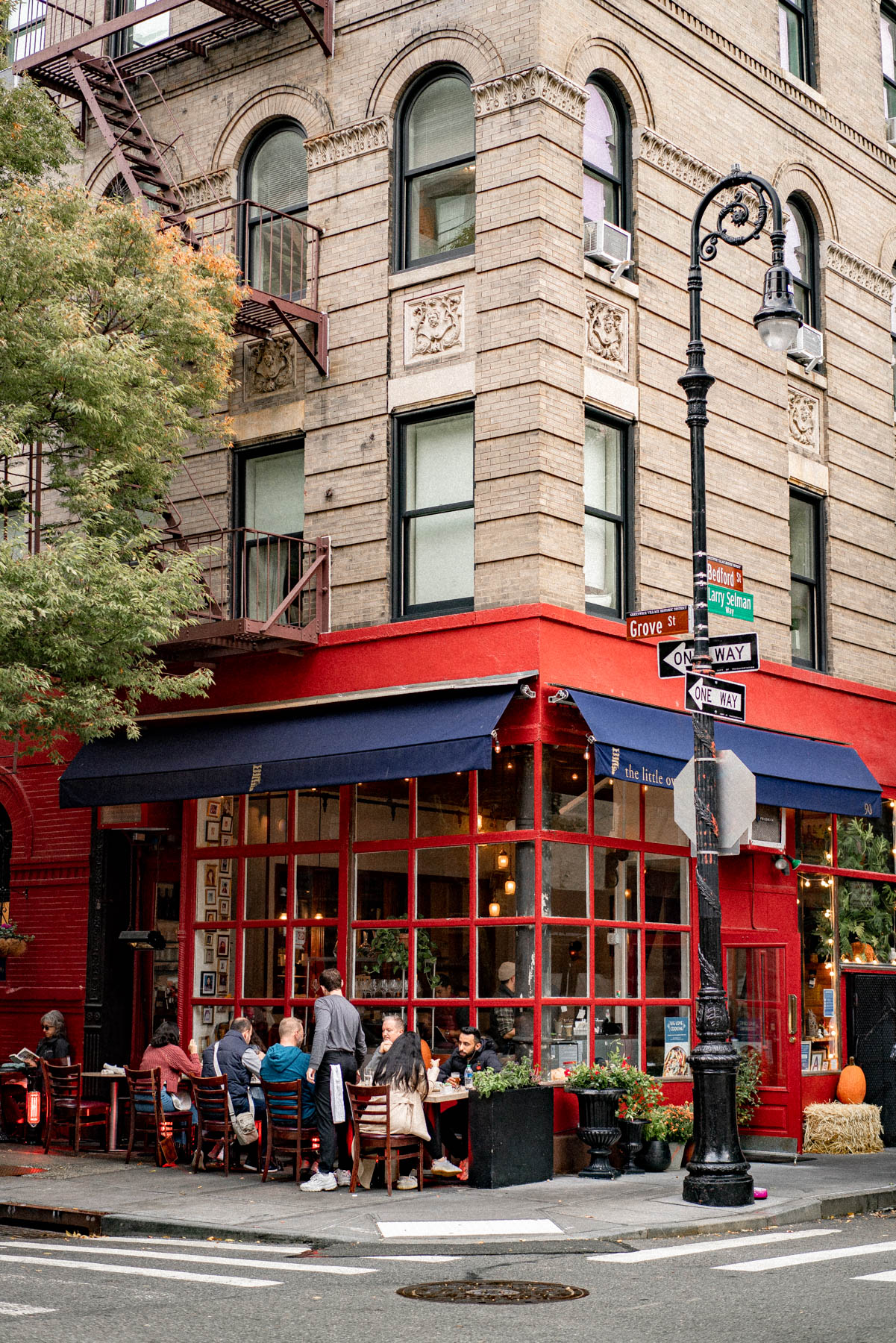
The Little Owl · West Village
What you can skip, at least at first. A big couch, until you have measured the stairs and lived in the space enough to know where it should go. A dining table, because in a small apartment a folding table or a bar counter usually does the job and gives you your floor back. Anything heavy and permanent, for all the reasons above. And decor. I know it is tempting to buy the art and the rug and the throw pillows on day one, but live in the raw space for a couple of weeks first. The apartment will tell you what it needs. The rug I bought before I understood the light was completely wrong for the room, and it sat rolled up in a corner for months, mocking me.
The honest downside I will state plainly. Setting up a first place here is more expensive and more physical than anyone tells you, and it will take longer than a weekend. You will make a couple of dumb purchases. You will curse your stairs. That is the tax, and you pay it once, and then you have a home in the greatest city on earth. If you are still figuring out whether the whole thing pencils out, my breakdown of what it actually costs to live in NYC in 2026 lays the real numbers out with no sugarcoating.
The stuff that makes it feel like home
Logistics aside, the part that catches you off guard is how fast a bare New York box turns into the place you love most in the world. It is not the furniture that does it. It is the deli guy who starts your coffee when he sees you coming. It is figuring out which laundromat has the good folders. It is the window that catches afternoon light you did not know to look for when you signed the lease. My smallest, most inconvenient, fourth-floor-walk-up apartment is still the one I get nostalgic about, wonky wiring and all.
 dearest-nyc-1003176-1.jpg
Central Park · Central Park
A few last things I would tell any friend moving here. Meet your neighbors early, because in a walk-up they are your package holders, your emergency plunger lenders, and occasionally the buyers of the couch that would not fit. Learn the building’s unspoken etiquette fast, and for a head start there, I wrote up the unwritten rules of NYC that nobody tells you. And if you are still deciding which corner of the city to plant yourself in, spend real time with my honest guide to NYC neighborhoods first, because the block you choose shapes your daily life more than the apartment does.
Set it up piece by piece. Buy what fits up the stairs. Get the AC bracket. Find your laundromat. The rest fills in on its own, and one ordinary Tuesday you will realize the bare box became yours without you noticing.
What did you wish you had known before setting up your first place here? Tell me the thing that humbled you.
Until next time,
Antonina